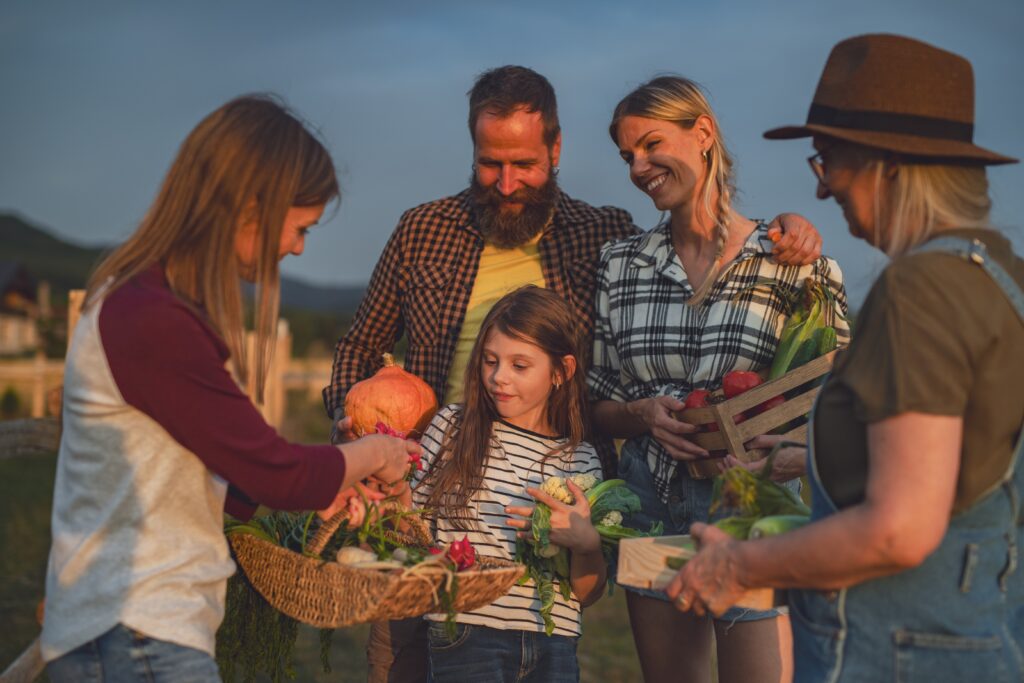
On Sunday, we dug into a story about a community that pledged their financial support for locally grown food—out loud, in a circle, in vulnerable relationship with one another. As you may recall, one year a participant family was unable to contribute due to the circumstances of their lives. Still, they sat in the circle and pledged zero, and the rest of the community held them in care during a difficult time. The others in the community made up the difference, the budget was met, and the project continued on.
We never find out what happened the following year. That’s not part of the story provided to us. What I would like to think—what I would envision if our Unitarian Universalist values undergirded those relationships—is that the family had some space to secure or create some income. And the next time they sat in the circle, they could name an amount they could contribute to the overall budget for their community’s food. Maybe some other family needed to pledge zero that year. Or maybe everyone was able to pledge what felt like just the right amount.
As I mentioned on Sunday, there are no volunteers in churches. Members of a spiritual community all contribute to what gets co-created. There are times when we need to pledge less than we did the year before, but maybe there is space for us to contribute more of our time in meaningful ways. Maybe there are years when we have heavy demands on our time, but our financial resources are more abundant. It’s a very personal bit of discernment to determine what makes sense for us to commit to, and as members of a collective body, we all hold some responsibility for the well-being of the community. We are all still worthy of love and belonging, whatever that discernment leads us to contribute.
So, the message of the story about pledging zero is kind of complicated. We need to know that a community can hold us and care for us, and we also need opportunities to hold and care for others. Our relationships are always in a context of mutuality and interdependence, rather than some kind of equation about who needs or receives more or less than others. Everyone doing their part doesn’t mean everyone doing exactly the same thing or contributing exactly the same amount of time or care or resources.
When the people in the story sat around in a circle, they might have been tempted to compare their contributions with one another. They might have experienced some judgment about how much one household gave compared to other households. We have no idea what kinds of thoughts flitted through their very human minds. But at the end of the day, they chose to be interwoven with one another’s lives and committed themselves to the literal nourishment of their community. The budget was met. People were fed. That was the most important thing.
So, what is the most important thing for our spiritual community? If we set aside the judgments and the fear of embarrassment and the comparisons and the toxic societal calculus of worthiness, what is it that we’re really committed to creating together? Our congregation could be a place of deep belonging and profound connection for many generations to come, but that doesn’t happen by accident. It takes people willing to do things differently—to do commitments and mutual care differently—than what happens in a lot of places in our society.
Liberating love is not a lofty ideal or a far off vision for some distant hopeful future. It’s an invitation for us. For you. Liberating love is what we have the potential to offer one another and receive from one another. I hope you see that possibility and embrace it.